Introduction
Vibratory feeders play an important role in modern manufacturing by supplying, orienting, and transferring components to assembly lines, packaging machines, inspection stations, and automated production systems. Consistent feeding is essential to maintain production speed, minimize interruptions, and improve overall machine efficiency.
However, conventional vibratory feeder systems may require repeated mechanical adjustments to achieve the desired feeding rate. Variations in supply voltage, component characteristics, feeder design, and operating conditions can also affect performance.
A frequency-controlled vibratory feeder controller offers a more flexible approach by allowing operators to adjust vibration characteristics electronically. With features such as independent frequency and amplitude adjustment, mains voltage compensation, and PLC compatibility, modern controllers can help simplify feeder setup and improve process consistency.
-
Why Is Consistent Vibratory Feeding Important?
In automated production, an inconsistent supply of components can affect the entire machine cycle. Insufficient feeding may cause production delays, while excessive feeding can lead to component accumulation, jamming, or improper positioning.
Common challenges include:
- Inconsistent feeding speed.
- Repeated adjustments during machine setup.
- Variations in vibration due to electrical supply fluctuations.
- Difficulty matching feeder performance with changing production requirements.
- Manual intervention when production speed or component types change.
Selecting a suitable vibratory feeder controller can help address these challenges and support more reliable automated operation.
-
How Frequency Control Reduces Mechanical Tuning
Traditional vibratory feeder systems may depend on mechanical adjustments to achieve suitable feeding performance. Operators may need to modify feeder settings, inspect mechanical components, or repeat tuning procedures when changing the application or operating conditions.
A frequency-controlled controller provides an electronic means of adjusting the vibration frequency to suit the feeder and the components being handled.
By adjusting frequency and amplitude independently, where supported by the controller and feeder design, operators can fine-tune vibration characteristics without relying exclusively on repeated mechanical adjustments.
This can help to:
- Reduce setup and commissioning time.
- Simplify adjustments when changing components or feeding requirements.
- Minimize unnecessary manual intervention.
- Improve the repeatability of feeder settings.
- Support faster changeovers between production runs.
Important: Frequency control does not eliminate every mechanical adjustment. Correct bowl tuning, spring selection, mounting, and feeder condition remain important. The objective is to reduce avoidable mechanical retuning and make routine operating adjustments easier.
-
Why Mains Voltage Compensation Matters
Electromagnetic vibratory feeders are sensitive to the electrical conditions supplied to their drive systems. Variations in mains voltage can influence vibration intensity and, consequently, the rate at which components move along the feeding track.
Automatic mains voltage compensation helps the controller maintain more consistent output behavior when the incoming supply voltage fluctuates within its specified operating range.
Potential benefits include:
- More consistent vibration intensity.
- Reduced sensitivity to moderate supply voltage fluctuations.
- Fewer manual readjustments during operation.
- Improved repeatability of feeding performance.
Voltage compensation is particularly useful in installations where supply conditions vary. However, it cannot compensate for every electrical or mechanical disturbance, and its effectiveness depends on the controller design and the feeder application.
-
Independent Frequency and Amplitude Adjustment
Frequency and amplitude influence different aspects of vibratory feeder behavior.
Frequency determines how rapidly the feeder vibrates, while amplitude relates to the magnitude of its movement. Their combined effect on feeding speed and component movement depends on factors such as bowl geometry, track design, spring characteristics, component shape, and loading.
Independent adjustment provides greater flexibility when optimizing feeder performance.
For example, a lightweight component may require a different vibration setting from a heavier component, even when both are handled by the same type of feeder. Electronic adjustment makes it easier to explore suitable operating settings and establish repeatable parameters for each application.
The objective is not simply to increase vibration, but to achieve stable, controlled movement appropriate to the components being fed.
-
PLC-Compatible Control for Automated Production
Modern manufacturing increasingly relies on PLCs, HMIs, sensors, and centralized machine control systems. Vibratory feeders must therefore work effectively within the overall production sequence.
A PLC-compatible feeder controller can accept suitable external control signals to support coordinated operation. Depending on the available interfaces, these may include:
- 0–10 V DC external amplitude setting.
- Remote start and stop commands.
- Integration with machine operating sequences.
- Feeder enable and disable commands linked to production demand.
- Coordination with sensors, component detection, and downstream equipment.
For example, a PLC can enable a feeder when a downstream assembly station requires components and stop or reduce feeding when the required quantity has been reached, provided the controller and machine logic support these functions.
This approach can help reduce unnecessary feeding, minimize component accumulation, and improve coordination between the feeder and the production line.
-
Smooth Start and Stop for Controlled Operation
Abrupt changes in vibration can sometimes cause unwanted component movement or inconsistent feeding during startup and shutdown.
A controller with adjustable ramp-up and ramp-down functions can gradually change the output according to its configuration. This allows the feeder to transition more smoothly between operating states.
Controlled starting and stopping can be useful in applications where component positioning, downstream synchronization, or material accumulation needs careful management.
The actual improvement depends on the feeder mechanics, the material being handled, and the controller’s available ramp settings.
-
Electrical Protection and Easy Digital Adjustment
A feeder controller should also provide convenient operation and appropriate electrical protection.
A digital display and keypad allow operators to adjust parameters and monitor settings without repeatedly modifying mechanical components. Built-in protections, such as overcurrent and overvoltage protection where provided, can help protect the controller against specified electrical fault conditions.
Correct installation, earthing, wiring, and selection of protective devices remain essential. Controller protection should always be used in accordance with the manufacturer’s instructions and applicable electrical safety requirements.
Streamline Controls Private Limited offers the FEEDRkon Variable Frequency Vibratory Feeder Controller, designed for electromagnetic vibratory bowl feeders, linear feeders, and automated parts-feeding systems.
FEEDRkon combines electronic adjustment and control features to help manufacturers optimize feeder operation for different applications.
Key features include:
- Frequency control from 30–140 Hz: Adjustable output frequency for feeder tuning, independent of mains frequency within the controller’s specified operating conditions.
- Independent frequency and amplitude adjustment: Greater flexibility in optimizing vibration characteristics.

- Automatic mains voltage compensation (±10%): Helps maintain consistent operation within the specified compensation range.
- Soft start / stop: Adjustable ramp-up and ramp-down for controlled operation.
- PLC-compatible interface: 0–10 V DC external amplitude setting and remote start/stop.
- Electrical protections: Built-in overcurrent and overvoltage protection.
- Digital operation: Display and keypad for convenient parameter adjustment.
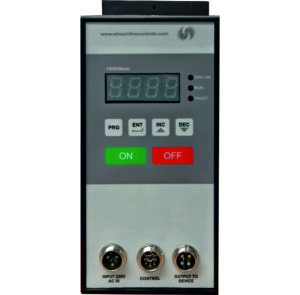
With these capabilities, FEEDRkon can help simplify feeder setup, reduce avoidable manual adjustments, and support integration into automated manufacturing processes.
As with any feeder control system, final performance depends on correct controller selection, feeder design, mechanical condition, and application-specific tuning.
-
Applications Across Manufacturing Industries
Frequency-controlled vibratory feeder controllers can be used in a wide range of applications, including:
- Automotive components: Feeding fasteners, clips, and small parts to assembly stations.
- Electrical and electronics manufacturing: Handling terminals, connectors, and other small components.

- Packaging machinery: Supplying components to filling, capping, labelling, and packaging equipment.
- Pharmaceutical and consumer goods machinery: Feeding suitable components into automated handling and packaging systems.
- General industrial automation: Supporting component sorting, orientation, inspection, and assembly.
- Weighing and dosing systems: Controlling vibration intensity for suitable material-feeding applications.
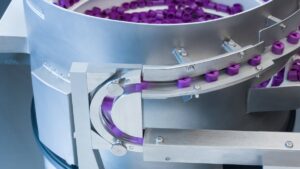
The controller and feeder should be selected according to the component characteristics, required throughput, environmental conditions, and control-system requirements.
Conclusion
Consistent vibratory feeding is an important part of efficient automated production. Frequency control, independent amplitude adjustment, mains voltage compensation, smooth start and stop, and PLC-compatible operation can help manufacturers reduce avoidable manual adjustments and improve control over feeding processes.
Although proper mechanical design and tuning remain essential, electronic control can simplify routine setup and make it easier to adapt feeder behaviour to different operating requirements.
FEEDRkon by Streamline Controls Private Limited is designed to support flexible, controlled, and automation-ready vibratory feeding for modern manufacturing systems.
For technical details, OEM enquiries, or a product demonstration, visit www.streamlinecontrols.com.