Description
FEEDRkon – Frequency Controller for Vibratory Feeder
FEEDRkon : Vibratory Feeder Controller is a digital frequency controller. Its designed for electromagnetic vibratory bowl feeders, linear feeders, and industrial parts-feeding systems. Its mains-independent output frequency control (30–140 Hz) enables electronic optimization of feeder performance. That’s why reducing the need for time-consuming mechanical spring adjustments and allowing faster setup and commissioning. The sinusoidal output current further contributes to smoother, quieter feeder operation.
With independently adjustable amplitude, consistent feeding performance despite ±10% AC mains voltage fluctuations and a 6 A rated output, FEEDRkon offers reliable and repeatable operation. Its PLC-compatible external control, optional RS-485 communication, programmable start/stop functions, and built-in electrical protections make it a versatile solution for industrial automation and OEM applications.
Why Choose Vibratory Feeder Controller : FEEDRkon?
- Faster Feeder Setup & Commissioning – Reduce the time and effort involved in mechanical spring tuning through electronic frequency adjustment.
- Quieter Feeder Operation – Sinusoidal output current helps minimize electromagnetic and mechanical noise.
- Consistent Feeding Performance – Maintain steady material flow even with ±10% AC mains voltage fluctuations.
- Flexible Feeder Control – Independently adjust frequency and amplitude to suit different feeder designs and feeding requirements.
- Easy Automation Integration – Interface with PLCs and machine control systems using external control inputs and optional RS-485 communication.
- Reliable Industrial Operation – Built-in electrical protections, programmable start/stop functions, and convenient digital operation.
Typical Applications for Vibratory Feeder Controller : FEEDRkon
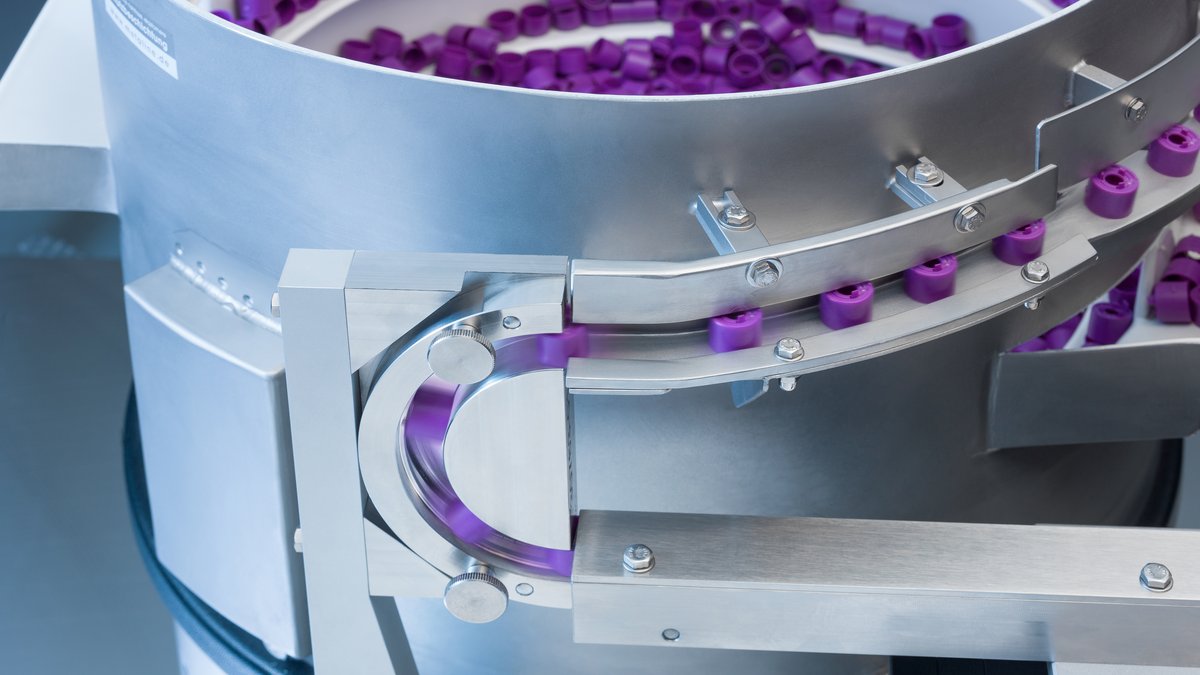
- Vibratory Bowl Feeders – Controlled feeding, orientation, and delivery of components in automated assembly systems.
- Linear Vibratory Feeders – Smooth and consistent movement of components along linear tracks and feeding channels.
- Vibratory Hopper Feeders – Controlled material discharge and replenishment of downstream feeding systems.
- Parts Feeding & Assembly Systems – Feeding of screws, fasteners, electronic components, and other small parts into automated machines.
- Weighing, Dosing & Packaging Systems – Adjustable feeding of compatible bulk materials, granules, and components for controlled material delivery.
Feature Highlights
Mains-Independent Frequency Control
- 30–140 Hz programmable output frequency, independent of AC mains frequency, allows feeder tuning according to mechanical design and operating requirements.
Amplitude Control
- 0–100% adjustable output amplitude enables precise control of vibration intensity and material feeding speed.
Consistent Feeding During Mains Voltage Fluctuations
- Maintains stable feeder output and consistent feed rate despite ±10% fluctuations in AC mains supply voltage.
Soft Start / Stop
- 0–4 seconds adjustable ramp-up and ramp-down for controlled starting and stopping of feeder vibration.
Programmable On / Off Delay
- 0–15 seconds adjustable delays support automated machine sequencing and process timing.
PLC & Remote-Control Integration
- 0–10 V DC external amplitude control for integration with PLCs and automation systems.
- Remote start/stop input for operation through external control signals.
- Optional RS-485 communication interface available on request.
Digital Operator Interface
- Digital display and keypad for amplitude adjustment, frequency setting, and parameter configuration.
- Displays operating status, amplitude setting, and output current.
- User and administrator parameter access levels.
Output Current Monitoring
- Real-time output current indication for monitoring feeder operation and assisting commissioning and maintenance.
Electrical Protection & Fault Diagnostics
- Adjustable overcurrent trip setting (0–6 A).
- Overvoltage and short-circuit fault detection.
- Fault indications for easier troubleshooting and maintenance.